“Do not let yourselves fall asleep in a false sense of security. Watch over yourselves. Do not forget that you are in a world where trials are never lacking. In the joys of peace, prepare yourselves for when you must fight.” (GS/11/VI/78/A. Vol. I, p. 393–294.)
The first memory I have of the Venerable Fr. Jean Gailhac goes back 40 years. A faded image, an old photograph (a daguerreotype perhaps?) in black and white. A man with a shy and serene smile. Simple in appearance, with a deep gaze turned toward an uncertain future, yet determined to embrace it with courage.
For all those who know his work and believe in his legacy, Gailhac’s future is always oriented toward others. The gaze and spirit of the man who smiles in the face of challenges have resisted the corrosive passage of time in the same way that the image has survived to this day. Fr. Jean Gailhac lives.
Fr. Jean Gailhac was always a man ahead of his time. In every action and every word. When, in Fátima, hundreds of students gathered to celebrate his life and work, we always sang filled with pride and admiration for the example he gave us. To each one of us.
“From a very young age, God instilled in me a great love for others… Without a doubt, I have responded very poorly to His graces… As for work, fatigue, and zeal for the works, I have spared no effort.” (GS/28/VIII/78/A. Vol. I, p. 415.)
I grew up in a school he never knew, yet where his message of peace, dedication, commitment, and generosity is lived with devotion. I entered very young—a boy of three years old. A good boy and not very wild, they say. The Sacred Heart of Mary School was my home until I was 17.
As a student, I was far from imagining that six years after leaving the school, I would embark on the adventure of journalism. Always motivated by helping others. By sharing with others. To inform others.
Six years later, a different adventure. I embarked for Timor-Leste to serve with the United Nations on a Peace Mission. “That all may have life,” I thought at the airport.
Today, by a happy coincidence, the RSCM have a project in the country, in Zumalai, for the “Education of Girls.” A project that offers some adventurous students in Portugal the opportunity to bring Gailhac’s spirit and message to the labarik (children) and manas (sisters) on the other side of the world.
In coming to know Gailhac’s words, actions, and work, his example accompanies us. It accompanies us happily—perhaps discreetly—but it is with us every day.
“Live in perfect union of charity… Let peace reign in each one.” (GS/4/I/75/A. Vol. I, p. 217.)
From a young age, Fr. Jean Gailhac chose to help those most in need, especially those living on the margins of society. Victims of deprivation—such as the poor, women, and girls who at that time lived and worked on the streets. The foundation of the “Refuge of the Good Shepherd” was created to restore dignity and promote social justice. Ultimately, “so that all may have life.”
During childhood, not once did I reflect on the role of women or gender in the Church. The Church was feminine. It was woman. I do not speak of the word, but of Mary. I speak of her spirit and of the mission of the Religious Sisters who entrust their hearts to her.
Sister Maria Augusta, Mother Visitação, Sister Luciana, Sister Maria, Sister Lurdes, Sister Filomena, Sister Lina, Sister Teresa, and so many, many other women of the RSCM Institute embraced with smiles the signs of the times and the daily challenges “proposed” by children—more or less well-behaved, more or less wild. Smiles, this time in color. And what extraordinary examples of life!
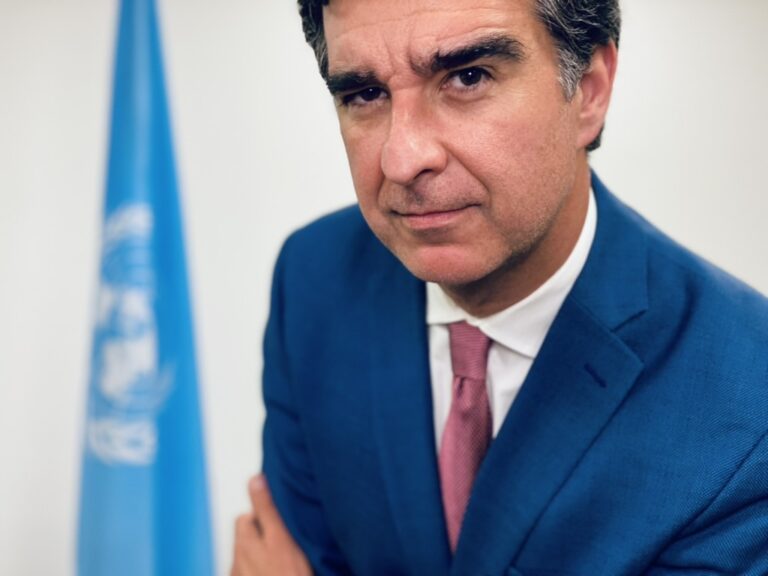
In 2011, a new adventure. I arrived in New York to serve at the United Nations headquarters, in the area of children’s rights, particularly protection from violence.
On March 7, 2017, early in the morning, during a train ride I took daily alongside the Hudson River, I met a woman. Nervous, she quietly repeated—almost anxiously—words she was trying to memorize for later delivery. She repeated facts and arguments. Arguments and facts.
The object of such contained agitation: a girl. Not just any girl—a valuable girl sculpted in bronze. The statue of the “Fearless Girl” would be placed the following day, on International Women’s Day, on a street in New York City’s financial district.
The occasion justified the anxiety. The girl, sculpted at life-size, would stand face-to-face, hands on hips, like a Portuguese bullfighter, challenging the enormous bronze bull that has lived on Wall Street since 1989.
Without warning, the nervous yet friendly woman asked me:
“Did you know there are fewer than ten statues of women in New York City—excluding those representing values like Liberty, Justice, etc.? Incredible, don’t you think?”
I was surprised by the question—and even more by the small number. I replied, surprised but calm, with a confident smile:
“I don’t think that number is accurate. In the Church of Saint Agnes alone, we have six statues of women,” I answered, with the pride of someone who grew up curious in a world of faith that embraced life, the signs of the times, and “where trials are never lacking.”
For several years at the UN headquarters, I actively participated in working groups focused on promoting equal opportunities for women within the Organization, including in peace missions.
In these and other discussions, I was fortunate to have nearby the RSCM representative, with NGO status at the United Nations, who—with a shy gaze but the confidence I knew so well from the RSCM—always made me feel at home, even thousands of kilometers from Portugal.
The proposals discussed often seemed somewhat outdated to me—outpaced by what had been my experience as a student and by Gailhac’s message. After all, I grew up educated in the Faith by courageous “authentic and joyful witnesses of the Gospel”—inspiring women who taught me to live in Mary, the woman who gives birth to the Church.
“The path of the just is the path of peace; that of sinners is full of disturbance, agitation, and remorse.” (GS/11/XII/75/B. Vol. I, p. 251.)
The distinction is clear. The choice is more difficult.
So often we try to contribute to peace in the world—the world around us, in our families, among friends, in our communities. But we try to reach the finish line before the starting point. We set off unprepared. Without fuel. Without Faith. Without watching over ourselves. Without the indispensable inner peace.
“Excessive activity and agitation harm the Work of God and inner peace, which we must not lose—even if it were to save the world,” Fr. Jean Gailhac reminded in 1880, in a letter that could have been written today.
Two hundred years after the death of the Venerable Fr. Jean Gailhac, the United Nations General Assembly declared the first decade of the 21st century and the third millennium as the “International Decade for a Culture of Peace and Non-Violence for the Children of the World.”
The first article of the Declaration and Programme of Action on a Culture of Peace speaks of “respect for life, the end of violence, and the promotion and practice of non-violence through education, dialogue, and cooperation.”
In the words and work of Fr. Jean Gailhac, these are fundamental values for promoting a culture of peace in the world:
“Respect and gentleness are necessary to preserve peace and charity in communities.” (GS/10/I/83/A. Vol. II, p. 388.)
“Educating children is one of the greatest works.” (GS/7/III/84/A. Vol. II, p. 452.)
“Everything old must pass away. Everything must be renewed.” (GS/17/XII/78/A. Vol. II, p. 27.)
Let us then follow this path proposed to us by Fr. Jean Gailhac. Let us venture into the unknown. Let us embrace the future as true messengers of peace, of joy, and of love—every day.
As His Holiness Pope Francis reminded us at the opening Mass of World Youth Day, celebrated in Lisbon in August:
“We have great help—a Mother—who, especially in these days, takes us by the hand and shows us the way: Mary. She is the greatest creature in history! Not because she had superior culture or special abilities, but because she never separated herself from God. Her heart was not distracted or corrupted; it was a space open to the Lord, always connected to Him. She had the courage to venture along the paths of the Word of God, and thus brought hope and joy to the world. Mary teaches us to walk through life!”
The phrase from the Gospel of John that we grew up seeing on the crosses of the RSCM—and upon which we reflected so many times at school, the one where the subject seems absent, almost like a “syntactic slip”—should be a life motto. One of constant search and curiosity.
Without fear of spreading peace. Without fear of the future or uncertainty. Always ready to embrace what is to come.
As students, we learned that the mission of the RSCM sisters is to bring God and His word to others—to make Him known. But what about us? What is our role—not syntactic, but personal—as messengers of peace “so that all may have life”?
Always intrigued by the role of each of us and by the best way to “complete” the beginning of this phrase that grew with me, the search became a true life project.
“Let us challenge one another to see who will love Jesus Christ more, who will imitate Him better, who will live more in Him and through Him; who will make one life with Jesus Christ.” (GS/17/XII/78/A. Vol. II, p. 27.)
I never imagined that my education at the school, in times of peace, would prepare me so solidly and securely for the battles of life.
Let us then accept the challenge, in the best way we can and know how.
Let us seek inner peace so that we may become full messengers of peace—first looking inward, and then, serenely, passing it on to others.
For the past five years, I have fought as a soldier of peace, alongside other firefighters, in a distant land. A new challenge. Always in Gailhac’s spirit.
In that humble mission, I found peace. I promoted peace—in the best way I knew how.
And I continue to do so. Every day.
With one single purpose:
“Ut Vitam Habeant / That all may have life.”
Original in Portuguese published on the website of the Religious of the Sacred Heart of Mary (RSHM)